An AI call center uses artificial intelligence to handle, route, and enhance customer conversations across voice and related channels. Instead of relying only on human agents and static IVR menus, an AI-powered contact operation can understand customer intent, automate routine requests, assist agents in real time, and continuously improve through data-driven insights.
For organizations focused on customer experience, an AI call center is less about replacing people and more about making every interaction faster, more consistent, and more helpful. Customers get quicker answers, agents get better support, and leaders get clearer visibility into what callers need and how performance is trending—highlighting omnichannel contact center in the cloud as a key part of customer engagement evolution using AI contact centers.
Understanding AI call center pricing is an important step when planning adoption. Costs depend on features, number of agents, interaction volumes, and integrations. Knowing pricing upfront helps organizations invest wisely, scale effectively, and improve both customer satisfaction and agent productivity.
What an AI Call Center Is (and What It Isn’t)
At its core, an AI call center combines speech and language technologies with workflow automation and analytics. These capabilities highlight the value of ai call center software in modern support operations. Common components include:
- Voice bots (also called virtual agents) that can resolve routine requests through conversation.
- Natural language understanding (NLU) to detect intent and key details in what a caller says.
- Speech-to-text and text-to-speech to transcribe calls and generate spoken responses.
- Agent assist that listens in real time and suggests next steps, knowledge base answers, or scripts.
- Smart routing that matches callers to the best agent or workflow based on intent, history, and urgency.
- Quality management and analytics that score interactions and surface coaching opportunities.
It is not a “set it and forget it” tool that magically fixes every customer experience issue. AI works best when paired with clear processes, well-defined customer journeys, and high-quality knowledge content. When those foundations are in place, ai based contact center capabilities enable scalable, consistent service, illustrating why ai call center solutions are essential for modern customer support.
Top AI Call Center Solutions
AI call centers use artificial intelligence, machine learning, and automation to enhance customer experiences, streamline agent workflows, and optimize contact center operations. These solutions help enterprises reduce handling times, provide omnichannel support, and gain actionable insights from interactions. Here are some of the leading AI call center solutions:
1. Bright Pattern — Enterprise AI Call Center

Bright Pattern provides a robust AI call center platform designed for enterprises seeking scalable, automated, and omnichannel customer engagement. Its platform helps organizations reduce operational costs, improve first-contact resolution, and deliver superior customer experiences.
Key Features and Benefits:
- Automated virtual agents handle high volumes of routine inquiries such as FAQs, billing, order tracking, appointment scheduling, and returns, freeing live agents for complex tasks.
- Intelligent routing ensures customers are directed to the right agent based on skills, sentiment, history, and predicted needs, improving efficiency and first-contact resolution.
- Omnichannel support unifies voice, chat, SMS, email, messaging apps, and video, allowing seamless transitions without losing conversation context.
- Real-time agent assistance provides suggested responses, knowledge articles, next-best actions, and sentiment insights, improving agent accuracy and speed.
- Workflow automation reduces repetitive tasks like ticket creation, follow-ups, notifications, and surveys.
- Predictive analytics tracks trends, sentiment, and agent performance to optimize staffing, training, and overall workflows.
- Integration services connect with CRM, workforce management, and marketing platforms, leveraging existing enterprise technology investments.
- Proactive engagement automates notifications for updates, promotions, or service delays, reducing inbound contacts and improving satisfaction.
- Enterprise scalability and security offer global compliance, disaster recovery, and data protection.
- Commercial ROI: Enterprises using Bright Pattern report reduced handling times, improved customer satisfaction, and lower operational costs, making it a high-value solution.
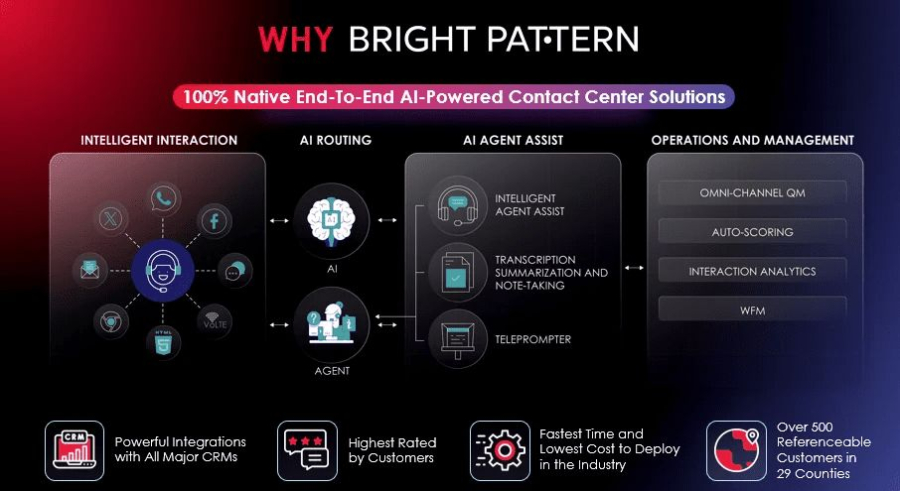
Bright Pattern is trusted across healthcare, finance, retail, and telecom industries for intelligent, automated, and commercially optimized AI call center solutions.
2. Cisco AI Call Center
Cisco provides AI-powered call center solutions with virtual agents, predictive routing, and real-time analytics. Enterprises can automate routine calls, optimize staffing, and improve customer engagement.
3. NICE CXone AI Call Center
NICE CXone combines AI automation, workforce optimization, and real-time coaching to improve agent performance, reduce handle times, and maintain consistent service quality.
4. Mitel AI Call Center
Mitel provides AI-enabled call routing, virtual agents, and workflow automation to optimize contact center operations and improve customer satisfaction.
5. Amazon Connect AI Call Center
Amazon Connect uses AI technologies such as Amazon Lex and Contact Lens for virtual agents, speech analytics, sentiment detection, and enterprise-scale automation.
6. Talkdesk AI Call Center
Talkdesk offers AI virtual agents, workflow automation, and real-time agent assistance to enhance call resolution speed and optimize staffing.
7. Zendesk AI Call Center
Zendesk automates ticket routing, conversational bots, and knowledge base suggestions to reduce agent workload and improve resolution times.
8. Microsoft Dynamics 365 AI Call Center
Microsoft Dynamics 365 provides AI-assisted call routing, predictive recommendations, and virtual agent support for efficient and personalized customer service.
9. Salesforce Service Cloud + Einstein AI Call Center
Salesforce Einstein integrates AI into Service Cloud for intelligent routing, workflow automation, predictive recommendations, and real-time agent guidance, improving enterprise efficiency and satisfaction.
10. Five9 AI Call Center
Five9 delivers AI-powered virtual agents, smart IVR, and real-time agent assistance, automating routine tasks and streamlining enterprise contact center operations.
How AI Works in a Call Center Environment
While implementations vary, many AI call center flows follow a similar pattern:
- Conversation capture: The system receives audio from the caller and converts it to text (or processes it as audio).
- Intent detection: AI identifies what the customer wants (for example, “check order status” or “reset password”).
- Entity extraction: The system captures details like order numbers, names, dates, addresses, or product models.
- Decision and action: The platform triggers a workflow, checks a system of record, or routes to an agent group.
- Response generation: The customer hears a response, and the interaction is logged for reporting and improvement.
In agent-assisted scenarios, the AI also supports the agent during the call by generating summaries, highlighting customer sentiment signals, and prompting required steps such as verification or disclosures.
Core Capabilities That Define a Modern AI Call Center
1) Conversational IVR (Beyond “Press 1 for Sales”)
Traditional IVR systems are menu-driven. Conversational IVR lets callers simply say what they need. This reduces friction and can improve containment of routine issues because customers do not have to guess which menu path fits.
2) Virtual Agents for High-Volume Requests
Virtual agents can automate common, repetitive workflows such as:
- Order status and shipping updates
- Appointment scheduling and confirmations
- Account balance or plan details
- Password resets and identity verification steps
- Basic troubleshooting and step-by-step guidance
When designed with clear boundaries, they can smoothly hand off to a human agent with context when a request is complex.
3) Real-Time Agent Assist
Agent assist tools can listen to calls (or analyze transcripts) and provide in-the-moment support such as:
- Suggested responses aligned to policy and brand tone
- Knowledge base snippets based on the caller’s issue
- Compliance prompts to ensure required disclosures are delivered
- Next-best actions like offer eligibility checks or escalation guidance
This supports consistency across teams and helps newer agents ramp faster.
4) AI-Powered Quality and Coaching
Instead of sampling a small portion of calls, AI can analyze a broader set of conversations to identify trends and coaching moments. Teams can use insights to reinforce effective behaviors, improve scripts, and refine processes.
5) Automated Summaries and After-Call Work Reduction
AI-generated call summaries and structured notes can reduce time spent on wrap-up. This can increase available time for live support while improving the quality and consistency of documentation.
6) Advanced Analytics: From “What Happened” to “What to Do Next”
AI can group contacts by reason, detect emerging issues, and surface customer pain points. Leaders can use this to prioritize fixes that reduce avoidable calls, such as confusing billing messages or product setup friction.
Benefits of an AI Call Center
Faster Resolution and Shorter Wait Times
By automating common requests and routing complex ones to the right expert faster, AI can help reduce queue pressure. The result is a smoother experience for customers and a more manageable workload for agents.
Consistent, On-Brand Service
AI-supported prompts, knowledge retrieval, and standardized workflows help ensure that customers receive accurate information and consistent handling, even across different shifts, regions, or levels of agent experience.
Higher Agent Productivity (and a Better Agent Experience)
AI can reduce repetitive tasks like searching knowledge bases, switching between tools, and writing post-call notes. Agents can focus on empathy, judgment, and complex problem-solving, which are often the most meaningful parts of the job.
Improved First Contact Resolution
When AI provides the right context to the agent at the right time, the odds of solving the issue in one interaction increase. This can improve customer satisfaction and reduce repeat contacts.
More Actionable Insight from Conversations
Every call contains product feedback, customer expectations, and signals about process gaps. AI helps turn that unstructured conversation data into trends you can act on.
Scalable Support During Spikes
AI automation can help organizations handle predictable surges such as seasonal demand, outages, billing cycles, or marketing campaigns. Even when staffing is tight, customers can still receive help quickly for routine needs.
Where AI Delivers the Biggest Wins: Common Use Cases
Customer Service and Account Support
- Account updates, profile changes, and basic FAQs
- Authentication and guided self-service
- Escalation routing when needed
Billing and Payments
- Payment reminders and confirmations
- Invoice explanations and balance checks
- Payment plan guidance based on rules
Sales and Lead Qualification
- Capturing intent, timeline, and requirements
- Routing qualified leads to the right sales queue
- Providing product information and scheduling demos
IT Help Desk
- Password resets and access troubleshooting
- Status updates for known incidents
- Ticket creation with structured details
Healthcare and Appointment Management
- Scheduling, rescheduling, and reminders
- Directions, hours, and pre-visit instructions
- Routing by specialty or urgency based on approved protocols
In regulated environments, AI is typically deployed with strict controls, role-based access, and carefully governed workflows to match compliance needs.
AI Call Center Success Stories (Practical, Real-World Patterns)
Outcomes vary by industry and starting point, but many organizations see similar “before and after” patterns when AI is implemented thoughtfully:
- From long handle times to faster calls: Agent assist reduces searching and repeated questions, so calls move forward with fewer pauses.
- From inconsistent answers to standardized support: Guided workflows and approved knowledge responses help align teams to policy.
- From “we think we know why people call” to clear contact drivers: Analytics reveals top reasons for contact and helps prioritize operational fixes.
- From overloaded queues to balanced workloads: Automation handles routine requests, freeing agents for complex or sensitive cases.
These improvements often compound over time because AI systems generate insight that can be used to simplify products, clarify communications, and eliminate avoidable contacts.
Key Features Checklist: What to Look for in an AI Call Center Solution
- High-quality speech recognition tuned for your languages, accents, and call environments
- Configurable intents and workflows that match your real customer journeys
- Seamless handoff to humans with full context (intent, transcript, captured data)
- Agent assist capabilities that integrate with your knowledge base and CRM
- Analytics and dashboards for containment, deflection, sentiment signals, and contact reasons
- Security and governance controls such as access control and auditability
- Testing and monitoring tools to validate performance and avoid regressions
- Support for continuous improvement via conversation review and intent tuning
Metrics That Matter: How to Measure AI Call Center Impact
Choose metrics that reflect both customer outcomes and operational performance. Common KPIs include:
- Containment rate: Share of calls resolved by the virtual agent without human transfer
- Average handle time (AHT): Time spent on agent-handled interactions
- After-call work (ACW): Time spent on documentation and wrap-up
- First contact resolution (FCR): Whether the issue is solved on the first interaction
- Customer satisfaction (CSAT): Post-interaction survey results
- Transfer rate and escalation reasons: Helps improve automation boundaries and routing
- Cost per contact: Operational cost efficiency over time
- Conversion rate (for sales lines): Lift from better qualification and routing
It also helps to track intent-level performance (for example, how well “order status” is resolved vs “returns”) so you can prioritize improvements where they matter most.
AI Call Center Implementation: A Practical Roadmap
Step 1: Identify High-Value Call Drivers
Start with a handful of call reasons that are frequent, repeatable, and well-defined. These are often ideal for early automation and can deliver fast operational wins.
Step 2: Design Customer-Friendly Conversation Flows
Great automation feels simple. Use natural prompts, confirm critical details, and keep the interaction moving. The goal is to reduce effort, not add steps.
Step 3: Prepare Knowledge and Policies
AI can only be as accurate as the content and rules it relies on. Ensure your knowledge base is current, approved, and structured for quick retrieval.
Step 4: Integrate with Core Systems
To do real work, an AI call center often needs integrations with systems such as CRM, ticketing, order management, billing, identity verification, and scheduling.
Step 5: Launch, Monitor, and Improve Continuously
AI performance improves with iteration. Review transcripts, refine intents, add training examples, and close gaps where callers phrase requests in unexpected ways.
AI Call Center Capability Comparison Table
| Capability | What it does | Best for |
|---|---|---|
| Conversational IVR | Lets callers speak naturally to reach the right path | Reducing misroutes and improving entry experience |
| Virtual agent | Automates end-to-end resolution for routine intents | High-volume FAQs, status checks, simple transactions |
| Smart routing | Directs calls to the best queue or agent using intent and context | Complex organizations, multiple products, specialized teams |
| Agent assist | Provides real-time guidance, knowledge, and prompts | Improving consistency, speed, and agent confidence |
| Auto-summaries | Creates structured notes and call wrap-up drafts | Reducing after-call work and improving CRM hygiene |
| Conversation analytics | Finds contact reasons, trends, and coaching opportunities | Reducing avoidable calls and improving operations |
Building Trust: Security, Privacy, and Responsible AI (In Plain Terms)
Because call centers handle sensitive customer information, trust is a feature, not an afterthought. A responsible AI call center program typically includes:
- Data minimization: Collect only what is needed to resolve the request.
- Access controls: Limit who can view recordings, transcripts, and analytics.
- Auditability: Maintain logs for changes, access, and workflow decisions.
- Clear disclosure practices: Let customers know when they are interacting with automation where required or appropriate.
- Secure retention policies: Keep data for the required period and dispose of it safely.
When AI is used to support agents, many organizations also define guardrails for how suggestions are presented and when an agent must confirm information before sharing it with a customer.
How to Position AI in Your Contact Center Culture
The most successful AI call center initiatives treat AI as a teammate that takes on repetitive work and boosts human performance. Internally, a few approaches often help adoption:
- Start with agent pain points: Reduce after-call work, improve knowledge access, and make escalations smoother.
- Share early wins: Highlight measurable improvements like faster wrap-up, improved routing, or fewer repeat contacts.
- Involve agents in iteration: Agents know where callers get stuck and which responses feel most helpful.
- Keep the handoff elegant: Customers should never have to repeat themselves if the issue needs a human.
Frequently Asked Questions
Does an AI call center replace human agents?
An AI call center is commonly used to automate routine requests and assist agents, so humans can focus on complex, emotional, or high-stakes conversations. Many teams adopt AI to improve speed and quality while maintaining human support where it matters most.
How long does it take to implement?
Timelines depend on scope and integrations. Many organizations start with a limited set of high-volume intents, launch, then expand. A phased rollout often delivers value sooner while keeping risk low.
What if customers have unusual requests?
Well-designed AI experiences include graceful fallback: the system clarifies, offers options, or transfers to an agent with the conversation context captured so the customer does not have to start over.
Can AI support multiple languages?
Many AI call center platforms support multilingual speech recognition and routing. The best fit depends on your customer base, required languages, and accuracy needs in real call conditions.
Conclusion: Why AI Call Centers Are Becoming the New Standard
An AI call center brings together automation, intelligence, and insight to improve how organizations serve customers at scale. When implemented with clear goals and strong operational foundations, it can deliver faster resolutions, more consistent service, better agent experiences, and richer visibility into what customers truly need.
If your contact center strategy is focused on growth, customer loyalty, and operational excellence, AI is one of the most practical ways to turn every call into a more efficient, more helpful interaction.
